
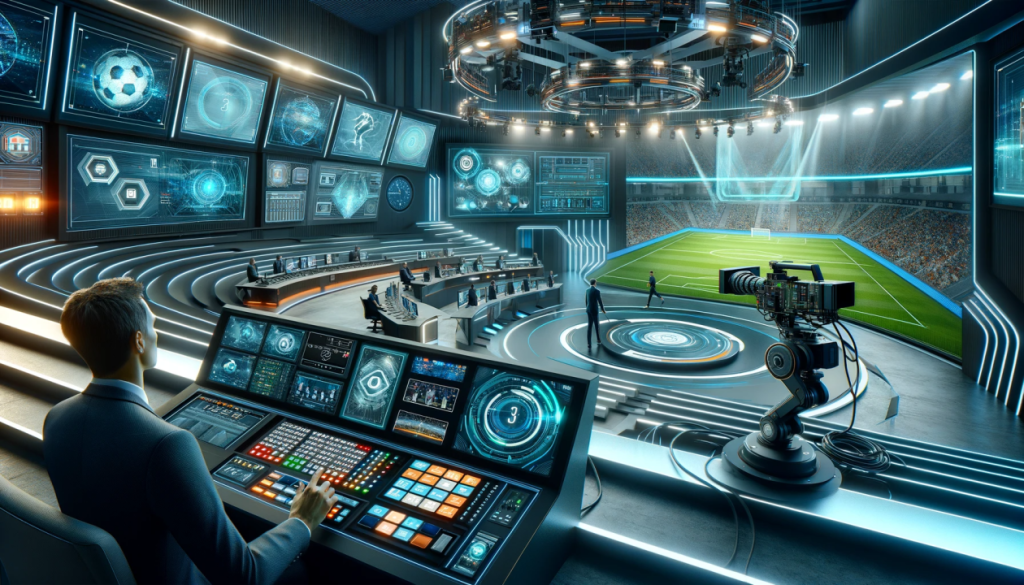
Beyond the Camera Lens
Once upon a time, sports broadcasts were simple: one camera, one commentator, one screen.
Today, that simplicity is gone — replaced by a symphony of drones, sensors, and algorithms that turn every game into a living, breathing experience.
Modern 스포츠 중계 (sports broadcasting) has become an art form powered by innovation.
Technology doesn’t just show the game anymore — it enhances it, expands it, and sometimes even redefines it.
1. The Birth of Immersion
Fans used to sit and watch.
Now, they step inside the game.
Virtual and augmented reality broadcasts allow viewers to feel as if they’re on the field — standing next to the pitcher, skating alongside the hockey player, or hearing the crowd erupt from every angle.
With just a headset or mobile device, audiences can experience matches from multiple perspectives.
This sense of presence transforms passive watching into active participation.
Sports broadcasting is no longer just about showing the action — it’s about living it.
2. Drone Cameras: The New Sky View
Drones have revolutionized the visual language of sports.
From above, they capture the rhythm and geometry of play — the movement of players, the sweep of a pass, the pattern of a sprint.
Their mobility provides breathtaking perspectives once reserved for video games or cinema.
During marathons, drones follow runners through landscapes; in football, they reveal tactical formations with clarity unseen before.
They bring audiences closer, not just visually but emotionally — letting fans feel the flow of the game.
3. The Magic of Slow Motion
Slow motion remains one of broadcasting’s most powerful tools — a reminder that speed often hides beauty.
A goal in real time might last two seconds.
But slowed down, you see the precision of the foot, the arc of the ball, the goalkeeper’s desperate stretch.
It’s poetry revealed through physics.
Broadcasters use slow motion not just to explain plays, but to elevate them — transforming sport into art, one frame at a time.
4. 360° Cameras and Interactive Angles
The age of fixed perspective is over.
Now, viewers can control the broadcast itself — choosing their own angles, replays, and highlights.
360° cameras placed around stadiums allow fans to explore every corner of the field.
Interactive streaming platforms let users rotate the view, zoom in, or follow specific players.
For the first time, fans are co-directors of their own experience.
This interactivity makes 스포츠 중계 a two-way dialogue, not a one-way transmission.
5. AI and Real-Time Insights
Artificial intelligence has become the silent commentator beside the human one.
AI can analyze statistics, track player movements, and predict outcomes in real time.
Data overlays on screen — like sprint speeds, heat maps, and possession percentages — give fans a deeper understanding of strategy.
Meanwhile, automated camera systems use machine learning to follow the ball perfectly without human control, freeing broadcasters to focus on storytelling.
AI doesn’t replace emotion — it deepens comprehension.
It turns numbers into narratives.
6. The Sound of the Future
Advances in spatial and surround sound have changed how fans hear sports.
Microphones placed throughout arenas now capture every detail — the thud of a ball, the chatter of players, the swell of the crowd.
Audio mixing engineers blend these sounds like a live orchestra, placing viewers at the very center of the atmosphere.
In the best broadcasts, closing your eyes feels like being there.
Sound has become as vital to immersion as sight.
7. Cloud Broadcasting and Global Connection
With cloud-based systems, games can be streamed to millions with minimal delay, even from remote regions.
Broadcasters collaborate across continents in real time — editors in Seoul working with producers in London on the same live feed.
This global synergy means no moment of brilliance is ever missed, no fan ever left out.
Technology has democratized access — bringing professional broadcasting to every corner of the planet.
8. The Human Touch in a Digital World
Despite all the innovation, one thing hasn’t changed: the need for human emotion.
Technology provides tools, but it’s the broadcasters, editors, and commentators who give those tools meaning.
The best technology amplifies humanity — the voice breaking during a goal call, the pause during heartbreak, the laughter between plays.
The future of sports broadcasting isn’t about replacing people with machines — it’s about enhancing connection between them.
Final Thoughts
The evolution of 스포츠 중계 is a story of creativity meeting technology.
From drone shots to VR stadiums, every new tool adds another brushstroke to the masterpiece of live sport.
Because no matter how advanced the equipment becomes, the goal remains timeless — to make fans feel.
To remind them that behind every pixel and camera lies something deeply human: passion.